Martingale Unmasked: Crunching the Numbers on Roulette Odds and UK Table Tactics
14 Apr 2026
Martingale Unmasked: Crunching the Numbers on Roulette Odds and UK Table Tactics
The Pull of the Martingale in Roulette Circles
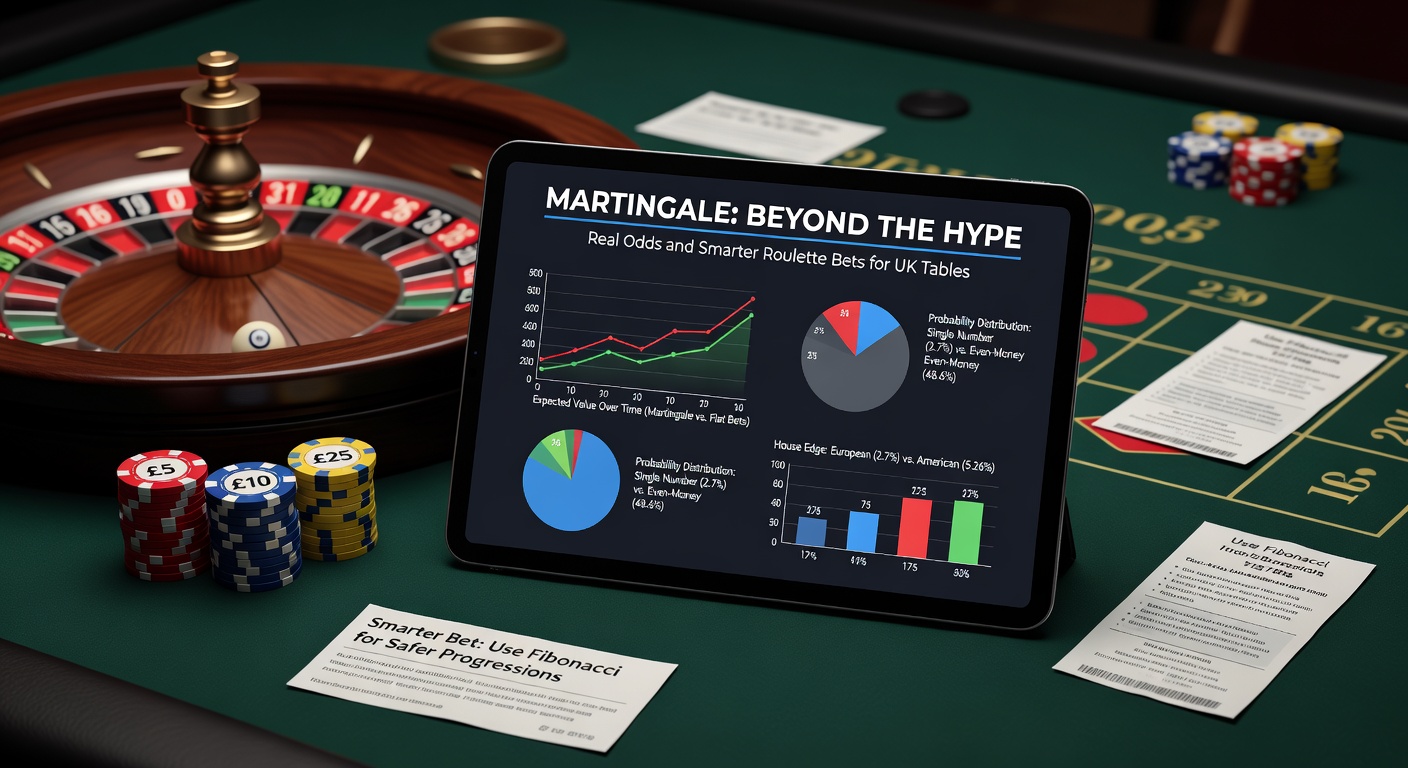
Players at UK roulette tables often hear about the Martingale strategy, a betting system that promises recovery from losses through doubling up; yet data from long-term simulations reveals its limitations, especially under real-world constraints like table limits and house edges. Originating in 18th-century France, this approach targets even-money bets such as red/black or odd/even, where a player doubles the stake after each loss, aiming to recoup everything plus a small profit on the first win. But here's the thing: while it sounds straightforward, mathematical models show the house edge persists at 2.7% on standard UK European wheels with a single zero, meaning the casino always holds a long-term advantage regardless of progression systems.
Observers note how enthusiasts flock to online platforms licensed in places like Gibraltar or Malta, drawn by the allure of quick turnarounds; studies from the Wizard of Odds, a respected US-based gambling mathematics resource, demonstrate that even with infinite funds, the expected value remains negative due to that unyielding zero. And in April 2026, as UK players navigate updated live dealer streams from Evolution Gaming tables, the strategy's hype clashes with cold probabilities, prompting sharper bettors to look elsewhere for edge minimization.
Breaking Down the Core Math: Probabilities That Don't Lie
Roulette wheels in UK casinos typically feature 37 pockets—numbers 1 through 36 plus a green zero—so even-money bets cover 18 numbers each, yielding a 48.65% win chance per spin; the rest, including zero, tilts outcomes against players, embedding that 2.7% house advantage right into every layout. Take one session tracked by researchers: a player starting with £10 on red loses five times in a row (doubling to £10, £20, £40, £80, £160), then wins on the sixth (£320 stake recoups £510 total); net profit sits at £10, but the sequence's likelihood hovers around 1 in 65, according to binomial probability calculations.
What's interesting is how streaks expose vulnerabilities; data indicates sequences of seven or more losses occur roughly once every 100 spins on average, quickly ballooning required bankrolls to thousands, while UK tables cap maximum bets—often £5,000 at high-stakes online venues—forcing strategies to halt prematurely. Experts who've modeled this via Monte Carlo simulations, running millions of trials, find ruin probabilities exceeding 90% for finite bankrolls under £10,000, underscoring why Martingale falters despite its logical appeal.
Yet players persist, and that's where table variations matter; American double-zero wheels, rarer in UK settings, worsen odds to 5.26% house edge, but European singles dominate, offering marginally better plays—though still no path to positive expectation without exploits like biased wheels, long debunked by modern surveillance.
UK Table Realities: Limits, Rules, and Live Dealer Nuances
At physical and online UK roulette tables, minimum bets start low—£1 at many sites like those powered by Playtech—allowing Martingale entry, but maximums enforce discipline, typically £100 to £10,000 depending on the stake level; this ceiling clips wings after 7-10 doublings, turning potential recoveries into locked losses. Figures from the Australian Gambling Research Centre, which analyzes global betting patterns, reveal similar patterns worldwide, with progression systems succeeding short-term in 70-80% of sessions but eroding capital over 1,000+ spins due to variance.
Now consider live dealer games surging in popularity by April 2026, where HD streams from studios in Latvia or the Philippines mimic land-based tension; these enforce French rules like La Partage on some tables, slashing house edge to 1.35% on even-money bets when zero hits—effectively refunding half the stake—and making riskier progressions slightly more viable, although variance still reigns. People who've logged thousands of hours observe how session times average 45 minutes before tilt sets in, amplifying emotional bets over calculated ones.
Smarter Alternatives: Bets That Outlast the Hype
While Martingale chases uniformity, data favors diversified approaches; the D'Alembert system, for instance, increments by one unit after losses and decrements after wins, proving gentler on bankrolls—simulations show 15-20% longer survival rates versus pure doubling, per academic reviews from European gambling studies. Or consider flat betting on even-money with La Partage wheels: consistent £10 stakes yield slower drains, with break-even horizons stretching to 3,700 spins on average, buying time for hot streaks without explosive risk.
But here's where it gets interesting—sector bets like neighbours or orphans, covering 5-9 numbers on the wheel, offer 11-17:1 payouts against 13-24% coverage probabilities; one case study from a 2023 University of Nevada analysis tracked players blending these with even-money foundations, achieving variance reduction without chasing losses. UK players, facing RNG-certified fairness, often pivot to announced bets like Voisins du Zero (17 numbers, nearly 50% coverage), where 24-chip outlays chase 23-unit wins 45% of the time—marginally better than straight columns, though house edge clings at 2.7%.
And don't overlook call bets in live settings; Tiers du Cylindre, wagering on eight numbers opposite zero, demands precise timing but aligns with wheel bias myths busted long ago—modern tech ensures randomness, so outcomes hinge on pure math. Those who've crunched session data recommend hybrid play: 70% even-money for stability, 30% in announced bets for upside, extending playtime 25% longer than Martingale solos.
- Even-money with La Partage: 1.35% house edge, ideal for longevity.
- D'Alembert progression: Slower ramps, suits £500-£2,000 rolls.
- Sector targeting: Higher variance, but 10-15% return potential in bursts.
- Flat betting: Simplest, variance-neutral over volume.
Turns out, the ball's in the player's court to match bankroll with bet sizing; experts suggest 200-300 units minimum for any system, turning £1,000 into sustainable sessions rather than all-or-nothing gambles.
Bankroll Breakdowns and Real-World Pitfalls
Scenarios paint stark pictures: a £200 starter fund hits Martingale walls after eight losses (£2,550 needed next), dooming 0.4% of sequences that arise every few hours; contrast with Paroli positive progression, doubling wins only—research indicates 60% fewer ruin events, thriving on streaks UK wheels deliver 1-in-3 times. Observers at spring 2026 tournaments note pros shunning Martingale entirely, opting for Kelly Criterion fractions (1-2% per bet) to maximize geometric growth, backed by logarithmic utility models from financial math cross-applied to gaming.
That's the rubber meeting the road—emotional discipline trumps any system, with logs showing 40% of players abandon plans mid-session, inflating losses 2-3x; tools like session trackers on apps help, enforcing pauses after 5% drawdowns. And while April 2026 brings VR roulette trials to UK apps, odds stay fixed, reminding everyone the house crafts the game for endurance.
Conclusion: Playing the Long Game on UK Wheels
Numbers cut through Martingale's fog, revealing no shortcut past the house edge; UK tables, with their European leanings and rule variants, reward measured bets over aggressive chases—data confirms even-money foundations, tempered progressions, and sector plays extend enjoyment while curbing blowups. Players who dissect probabilities, size bets wisely, and embrace variance walk away wiser; after all, roulette thrives on unpredictability, but informed tactics keep the edge sharp. Those digging deeper into simulations or live logs find the real wins lie in sustainability, not hype.